
How to find someone from a photo
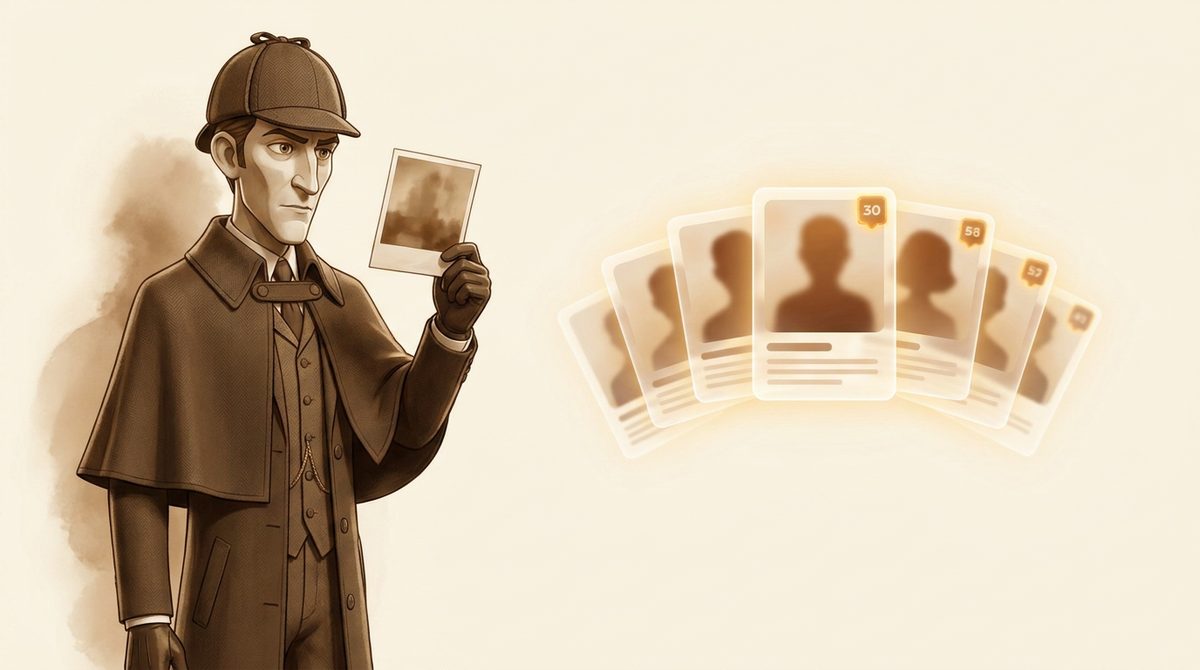
You have a photo and no name. A dating match who went quiet, a marketplace seller, a profile a friend has been talking to for months. There is an order that works, and most people run it backwards.
Step 1 — read the photo before you search it
Two minutes of looking beats an hour of searching. Zoom in and note the text in frame: shop signs, street names, a lanyard, a team badge, a receipt on the table. Note the uniform or branding. Note what repeats across several photos: the same living room, the same car, the same dog. Each of those narrows a country to a neighbourhood, and they cost nothing.
Step 2 — reverse image search first
It is free and takes fifteen seconds. Google Images, Yandex and TinEye each index different corners of the web, and Yandex is unusually strong on faces. If a stock photo or a lifted celebrity shot comes back, you are done, and the answer is bad news for whoever sent it to you.
Step 3 — face search when the file search comes back empty
An empty reverse image search does not mean the photo is genuine. It usually means the photo has never been republished as a file, which is exactly what you would expect from a real person posting their own pictures. Now switch from the file to the face.
A face search works differently: it measures the geometry between facial landmarks and looks for the same geometry anywhere it appears publicly. Other social accounts, dating profiles under a different name, forum avatars, a company team page. Crop to a single face, use the clearest photo you have, and run it.
Reading the result set
You get a list of pages, each with a source, a direct link and a similarity score. Work top down and open the links. What you are looking for is not one perfect match but a consistent story: three accounts, same face, same first name, same city, active over several years. That is a real person. One account created last month, with photos that also sit on someone else's five-year-old profile, is not.
Step 4 — pivot to the name and the username
The moment a face search hands you a plausible name, everything gets easier. A name plus one anchor, a city, an employer, a school, is enough to assemble the rest from ordinary web search.
And check the username, not just the name. People reuse handles far more than they reuse names. A handle that has existed since 2014 across six platforms is very hard to fake.
When everything comes back empty
- A genuinely small public footprint. Common with people who joined social media late or keep everything private.
- A photo too poor to search. Angle, resolution, occlusion. Try another photo before concluding anything.
- An AI-generated face. Increasingly common. Look for the tells: earrings that do not match, hair dissolving into the background, teeth that change count between shots, a background that makes no architectural sense.
An empty result is information too. A person who has existed for thirty years and left no public trace at all, while sending you photos daily, is telling you something.
The line
Finding out who someone is, to protect yourself, is reasonable and lawful in most places. Using what you find to turn up at their door, contact their employer, or pressure them is not. If a search confirms your worst suspicion, the right next step is to stop talking to them and report the account, not to investigate further.